
Personal Mastery
Designed to Engage

Skill Order empowers organisations to develop the next generation of leaders, equipping emerging managers with the skills and confidence to lead effectively while supporting long-term succession planning.
Successfully piloted at Mpact, the blended learning programme combines theory with practical application through a flexible mix of e-learning, face-to-face workshops and virtual classrooms, creating an engaging and well-rounded learning experience.
Purpose
The primary purpose of the course is to cultivate young leaders from multiple divisions by preparing them for critical roles within the organization, thereby ensuring continued growth and the preservation of the company culture.
The company needs young leaders with self-mastery skills who can:
- Define, align, and apply the company value system within the company
- Apply emotional intelligence and critical thinking to solve complex problems, and…
- Demonstrate a level of resilience in dealing with teams and situations.
The Personal Mastery training program addresses the above needs through six sequential modules. Each module is covered in a structured three-step process outlined below.
- E-learning pre-classroom preparation: Learners begin with online pre-classroom preparation that includes readings, assessments, and practice scenarios to introduce key concepts and promote self-reflection.
- Classroom sessions: E-learning is followed by interactive classroom sessions for discussion, collaboration, and the application of knowledge.
- Post-classroom activities: The course culminates in practical weekly journal activities to apply learning in real-world contexts. Continuous support is provided to enhance knowledge retention.
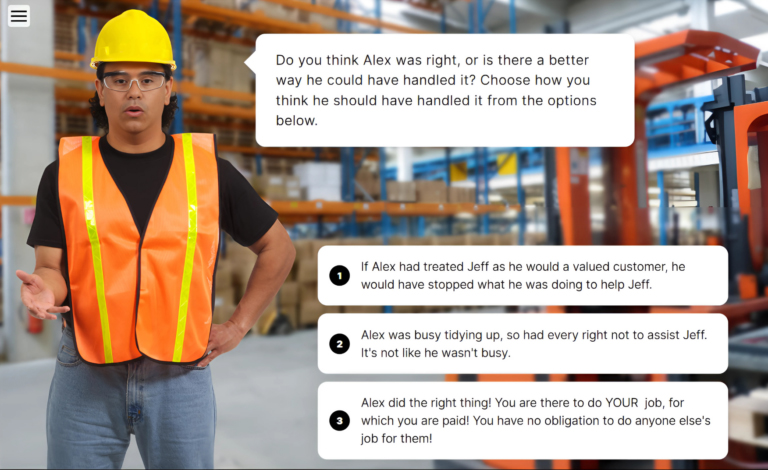
The questionnaire below is an example of a pre-classroom activity challenging learners to apply their knowledge and instincts to a difficult situation.
Key Considerations
Key considerations for developing the program included:
- Clearly communicating the purpose to the audience.
- Understanding the target audience’s learning preferences.
- Managing time constraints and coordinating logistics for participants from various regions.
- Create a strategy to identify future leaders and the best talent in the group.
- Evaluate the extent to which the program achieved its purpose.

Strategy
The blended model strategically aligns digital and classroom components.
- Pre-classroom work consists of interactive e-learning modules lasting 20 to 30 minutes, which cover theoretical content and presents thought-provoking scenarios for classroom discussions.
- Post-classroom work involves the practical application of learned skills and maintaining online diaries for tracking progress.
- Classroom sessions are designed to complement e-learning, allowing learners to discuss their ideas gleaned from the e-learning content and apply their knowledge in a supportive environment enriched by diverse experiences.
Evaluation
Ongoing evaluation includes:-
Short-term assessments of the learning experience (LX) and user experience (UX), and engagement and medium- and long-term measures of employee performance against key performance indicators (KPIs) such as:
- Team Productivity: Measure the output and efficiency of the team in achieving set goals.
- Employee Engagement: Track the level of involvement and enthusiasm employees under their leadership show towards their work.
- Customer Satisfaction: Evaluate feedback and satisfaction levels from clients or customers.
The ultimate goal is to determine if more young managers are effectively executing their roles, as indicated by improved overall team performance and productivity.
In summary, this training approach is designed to empower young leaders with applied knowledge and problem-solving skills. Furthermore, it promotes alignment with the company values in order to lead effectively while also providing a structured framework for continuous learning and evaluation.